
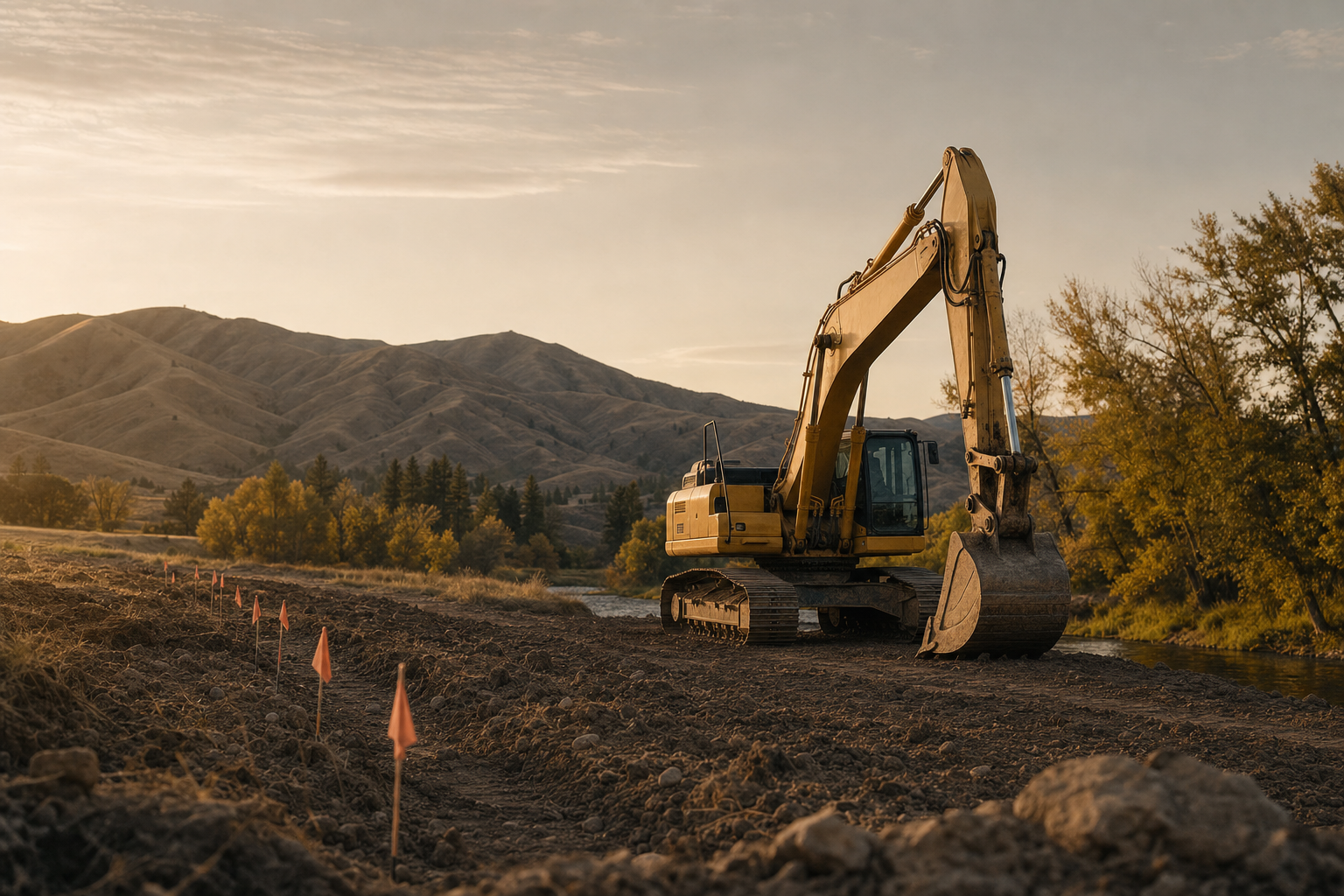
The excavators arrived at 6 a.m. on a Monday. That is not a metaphor. That is what a groundbreaking actually looks like — not a ceremonial gold shovel in a rented tent, but three tracked machines, a superintendent named Ray, and a survey crew that had already been on-site for two hours setting pins in cold July grass.
We had spent the previous eighteen months getting to that Monday. The plat had cleared Ada County in April. The URA reimbursement package had cleared the Middleton Urban Renewal Agency in May. The last easement — a sewer main crossing the neighbor's back forty — had been signed on the hood of a pickup truck the week before. Ray started grading at 6:04 a.m. We had coffee.
The plan, the ground, the difference.
Every developer will tell you that the site plan and the site are not the same thing. This is what they mean. The site plan for River Walk Ranch shows a graceful curve of a road along the river, forty homesites lined up like books on a shelf, a common green in the middle, and a small commercial cluster at the crossing. It is a beautiful drawing. We stared at it for a year.
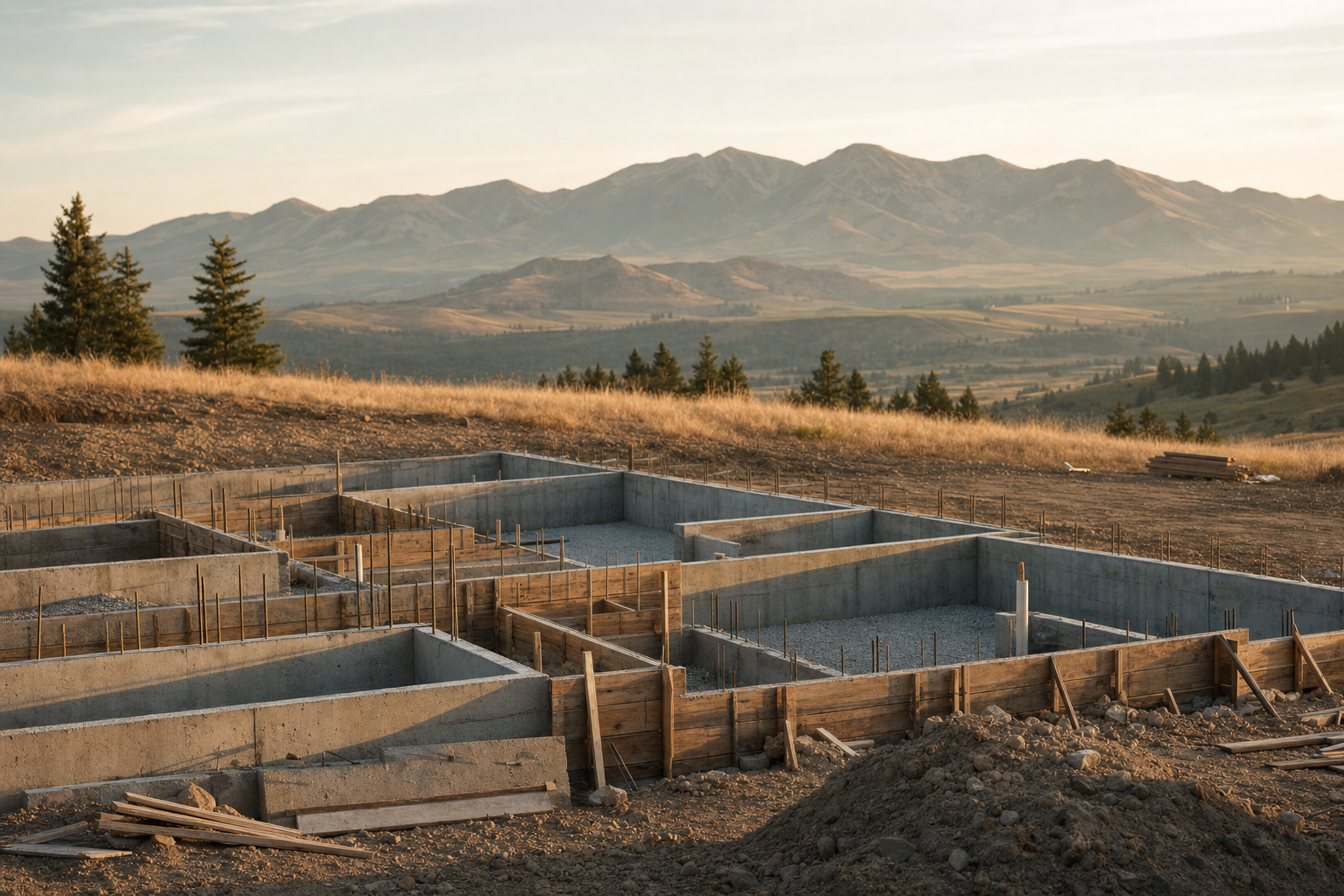
The site, when you actually walk it in the third week of grading, is more complicated. There is a hidden seep on Lot 14 that no one had marked. There is a mature cottonwood we are moving the road to save. There is a place along the river where the bank is unstable, and we have hired a geotechnical engineer to tell us how far back the trail needs to sit. The plan changes. The plan should change.
“The site is smarter than the site plan. It always is. Our job is to listen to it before we pour anything permanent.”
Sewer easements: the boring, essential thing.
Sewer easements are the least glamorous part of a development, and the most consequential. We spent Wednesday installing the mainline that carries wastewater from all forty future homes to the Middleton treatment plant. It runs under the eastern edge of the property, then jogs south across three neighboring parcels, then meets the trunk at the county road.
Each of those neighboring parcels has an easement recorded in the deed. Each easement was negotiated one landowner at a time, over kitchen tables and pickup trucks, over the course of nine months. One neighbor asked us to move the line six feet north to protect a family cemetery. We did. Another asked us to reseed with a specific pollinator mix. We did that too. The easement work is invisible when it's done well, and catastrophic when it isn't.
What we learned in the first thirty days.
Three things worth writing down.
One. The neighbors are not the enemy. Nine months of easement negotiation taught us that every landowner has a reason for the ask they're making, and every reason is worth hearing. The developer who assumes bad faith is the developer who ends up in court.
Two. The site is smarter than the site plan. See above. We have already moved the road twice and re-lotted the northeast corner once, and the community is better for it.
Three. The URA money is real, but slow. The Middleton Urban Renewal Agency has committed to reimburse a meaningful share of the infrastructure — sewer, water, roads, the crossing — and that reimbursement is what makes the price point for the homes possible. But it comes in tranches, on the URA's timeline, not ours. We planned for that. If we hadn't, we'd be borrowing at a rate that would show up in every mortgage on the ranch.
Next month.
By the next dispatch, we should be through rough grading on the eastern half, with the first road base going down and the sewer mainline pressure-tested. If the weather holds, we start on utility trenches by the end of August. If it doesn't, we don't. The site is smarter than us. We are trying to be smart enough to know it.
— A.P.